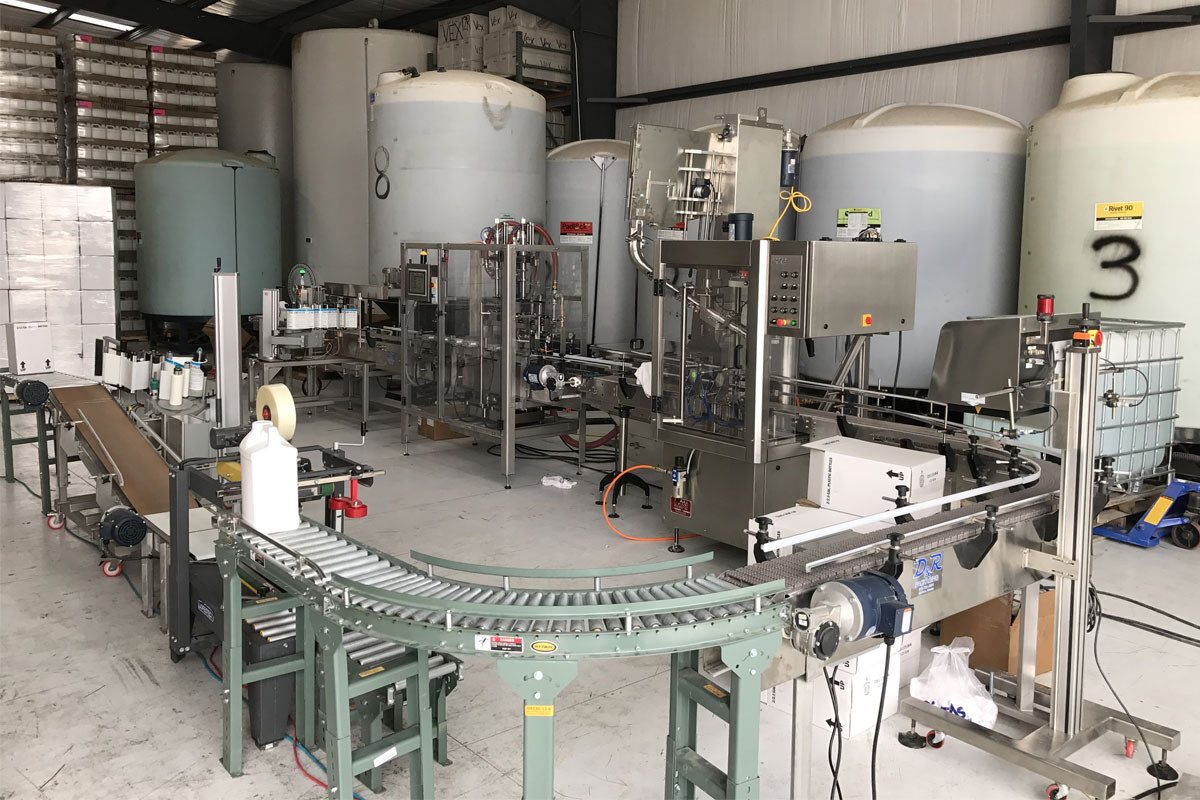
Every machine passes its own factory acceptance test, and the line still runs at 60 percent of the rate you paid for. That gap is one of the most common complaints we hear, and it rarely traces back to a single bad machine.
A turnkey integration packaging line closes the gap by putting one company in contract for how the equipment works together, station to station. Below are the problems we see disappear once that responsibility belongs to someone.
What a Turnkey Integration Packaging Line Actually Changes
Turnkey integration means one company owns specification, equipment sourcing across brands, controls, installation, commissioning, and support for the entire line.
Piecemeal buying assigns responsibility for each machine and nobody to the spaces between them. Packaging lines rarely fail at the machines. They fail at the seams.
One contract, One Line Rate
When five vendors each guarantee their own machine, no one has guaranteed your throughput. We validate rate at the line level and sign for it.
The Handoffs Get an Owner
Transfer points, guarding between stations, sensor placement, and cabling all belong to the integrator. On a multi-vendor job, they belong to whoever notices last.
Problems That Start Before Any Equipment Ships
Line Rate Math Nobody Owns
Rated speeds are not line speeds. Efficiency stacks multiply; they do not average. Five stations at 95 percent availability give you roughly 77 percent line availability.
Accumulation gets left out entirely, so a two-minute label roll change starves the filler and backs up the case packer.
Key Takeaway: Ask for line rate calculated with stacked efficiencies and changeover time included. A number that skips either one is a sales figure, not a production figure.
Product that Breaks the Handoffs
Each OEM tests with their own sample of your product. Nobody tests the sequence.
- Foaming or viscous product that fills clean, then drips at transfer
- Tacky containers that back pressure on mass flow conveyor
- Corrosive ag chem that degrades an unspecified belt
- Oval bottles that rotate in transfer and hit the labeler off registration
Controls Chosen by Accident
Mixed PLC platforms with no shared protocol. Three HMIs teaching operators three different logics. No line level emergency stop chain. No single data path for OEE reporting.
Controls architecture is the most expensive thing to retrofit later, so it deserves a decision rather than a default.
Layouts Drawn Around Machines Instead of People
Footprints that fit on paper and block the forklift lane. Compressed air CFM totaled after purchase. Drain slope ignored on a washdown line. Maintenance access designed out.
Pro Tip: Before you approve any layout, walk it with a maintenance tech and a forklift driver, not just an engineer. They will find the problems a drawing hides.
Problems That Surface During Build and Delivery
The White Space Between Quotes
Some line items appear in nobody’s scope. Transfer conveyors. Mounting brackets. Guarding between stations. Photo eyes. Cable tray and conduit. Air drops. Rigging. Integration labor.
Scope creep on a turnkey job is a change order you see coming. On a multi-vendor job it is an emergency purchase order written during startup.
Delays that Cascade
One late machine does not delay one machine. It idles the install crew, pushes the electrical contractor, and eats a production window you already promised a customer.
Machine-level acceptance tests pass in isolation. The line has never run as a line until it reaches your floor.
Finger Pointing that Costs Diagnostic Hours
The real cost of vendor disputes is the plant engineering time spent proving which machine is at fault before anyone starts fixing it.
With single source line integration, diagnosis and remedy sit in the same contract, so that clock never starts.
Need help scoping a full line project? Contact D&R Packaging for a no cost consultation and a straight answer on what your line actually needs.
Problems at Startup That Never Fully Go Away
Commissioning that Stretches into Weeks
Startup on a coordinated line is measured in days. On a fragmented line, each vendor waits on another to finish before dialing in their own equipment.
Fragmented Training and Scattered Spare Parts
Five manuals in five formats, no line-level standard operating procedure, and no changeover procedure across stations. Second shift often gets no formal training.
Spares are worse. The same proximity sensor carries different part numbers and lead times depending on which vendor sold the machine it sits on.
Safety Applied Station by Station
Guarding that stops at each machine’s edge leaves pinch points at every transfer. Emergency stop zones behave differently depending on which panel an operator reaches.
Our team designs guarding, stop zones, and documentation across the full line so an audit finds one consistent system.
Key Takeaway: Fragmentation does not end at installation. It shows up every changeover, every audit, and every time a part fails at 2 a.m.
What Turnkey Integration Does Not Fix
We would rather set expectations honestly than oversell the model.
Upstream Process and Product Problems
Inconsistent product density, unstable formulations, and poor container supply are process issues. A turnkey integration packaging line will expose them faster, but it will not solve them.
Budget, Staffing, and Machine Selection
Turnkey does not rescue an undersized capital budget or a thin maintenance program. It will not turn a poorly chosen machine into the right one. It means one company chose it and answers for it.
For a single machine dropped into a stable line, turnkey is usually the wrong structure. Buy the machine.
Pro Tip: Ask an integrator what they will not do for you. A straight answer tells you more than any capability list.
Is It an Integration Problem or a Machine Problem?
Seven Signs the Problem Lives in the Seams
- Machines hit rated speed individually, and the line does not
- Faults cluster at transfers rather than at stations
- Changeover takes longer than any single machine’s changeover
- Operators run one station in manual to keep the rest fed
- More than one HMI logic exists on one line
- Downtime cause codes come back as unknown or miscellaneous
- Troubleshooting begins with a conference call between vendors
Three or more, and the problem is not a machine.
Questions to Ask Before You Buy a Turnkey Integration Packaging Line
- Who validates line rate, and against what documented efficiency assumptions?
- Is a line-level acceptance test included, or only machine-level tests?
- Which brands can you source, and will you show a full cost benefit comparison?
- What are the commissioning acceptance criteria, and who signs off?
- Who answers the phone in year three?
D&R Packaging has designed, built, and integrated packaging equipment from Merriam, Kansas since 1986. We source competitive bids up and down the line rather than selling only what we build.
Ready to Get Your Line Running as One System?
Send us your current layout and target rate, and we will tell you where your seams are. Request a quote and see what a properly executed turnkey integration packaging line does for your throughput.