

















Net weight filling machines fill each container on a scale and stop at a target weight instead of a timer, a piston stroke, or a flow meter reading. Because the measurement is the product itself, the fill stays accurate when density shifts between batches. That is why chemical, petrochemical, and ag operations use them on products where every container has to leave the plant at a known weight.
D&R Packaging has designed and built this equipment from our Kansas City shop since 1986. We are family-owned, the owners are on every project, and the machines are made in the USA.
Four things happen at each fill station, and understanding them is most of what you need to evaluate any quote you receive.
It tares the container. The empty container is weighed in position, so bottle-to-bottle weight variation from the molder does not carry into your finished weight. More on tare weighing.
It fills to setpoints, not to time. The system opens a valve, runs a fast fill to get most of the product in, then steps down to a slow finish so it can land on the target weight cleanly. Those setpoints and the scale pre-acts live in a recipe.
It isolates the container on the scale. A gating system meters containers into the station, and a neck locator keeps the opening aligned under the nozzle. If the container is touching a conveyor rail or getting bumped, the scale cannot read cleanly, and the fill accuracy goes with it. Getting this part right is most of the engineering.
It measures outside the product path. The scale is not a wetted part. It never touches your product, which is why one machine can run a wide range of formulations without recalibrating a meter at every nozzle.
That last point is the practical difference between a net weight filler and a metered filler. A flow meter has to be calibrated against a scale, nozzle by nozzle, product by product. If the answer always comes back to a scale, it is usually cheaper and simpler to just fill on the scale in the first place.
Most buyers are really deciding between a semi-automatic bench unit and an automatic inline system. Here is how the two compare across the specifications that actually drive the decision.
| Decision point | Semi-automatic net weight filler | Automatic net weight filling system |
|---|---|---|
| How it runs | Operator loads, fills, and unloads each container | Conveyor and programmable gating; no operator at the fill point |
| Fill heads | One or two | Two or four. Four is the max: beyond it, indexing time eats the throughput gain |
| Container range | No fixed limits; best for 1 liter and up. Drums and IBC totes in scope | 16 oz to 5 gallons. For drums and totes, see our tote filling equipment |
| Scale and fill resolution | NTEP-certified, 1:5,000, 2–50 kg load cells. Fill resolution 0.1–0.5%. Floor scales for drums and totes | Same as the semi-automatic |
| Speed | Set by the operator's load and unload pace | Two heads on 2.5-gallon jugs: 10–14 per minute, depending on product |
| Accuracy | Same nozzles, valving, and scales as automatic | ±0.5% at full speed |
| Viscosity range | Non-viscous to nearly honey consistency | Same as the semi-automatic |
| Fill methods | Top, subsurface, or bottom-up, set per product | Same, stored per recipe |
| Changeover | Tool-less parts swap, recipe recall | Reset gates and neck locators, swap parts. About 10 minutes |
| Cleaning and construction | Flush-in-place standard; COP and CIP available. 304 stainless, Teflon gaskets, Viton O-rings; 316 optional | Same as the semi-automatic |
| Hazardous areas | XP models built to Class I, Div. 1: intrinsically safe sensors, pneumatic controls, purged or remote enclosure | Same as the semi-automatic |
| Fluid supply | Pressurized loops, centrifugal or diaphragm pumps | Same, sized to keep pace with the machine |
| Footprint | Compact; many fit on a workbench | Inline, sized with the rest of the line |
| Relative cost | About 25–50% of an automatic system | Higher, offset by labor and yield savings |
| Best fit | Small batches, pilot runs, many SKUs, tight floor space | Sustained volume, seasonal peaks, contract tolerances |
| Industries | Chemical blenders, ag chem, formulators, co-packers | Chemical, petrochemical, ag; also food, beverage, pet food |
The misconception worth clearing up: a semi-automatic machine is not a less accurate machine. It uses the same nozzles, the same valving, and the same scale decks as the automatic systems. What you give up is throughput, because a person is loading and unloading. What you gain is a much lower investment and a smaller footprint.
It also does not have to be a dead end. Many components carry over, so we can add fill stations, infeed and discharge accumulation, and product conveyance later to raise throughput without scrapping the original machine. Plenty of our customers keep the semi-automatic unit after they automate and use it for specialty runs and overflow.
See our semi-automatic and pail filling machines, or read Semi-Automatic vs. Fully Automatic Net Weight Filling Machines.
This is the reason most of our customers call us in the first place.
Fill by volume, and a density shift between batches changes the finished weight even though nobody touched the setting. The container looks right and weighs wrong. What follows is a verification loop: pull a container, put it on a scale, adjust the piston or the overflow or the timer, run again, weigh again. That loop costs time on every batch change, and more of it on lines running a lot of products.
Filling on a scale removes the loop. Calculate the target weight from the batch density, store it in the recipe, and the machine hits spec on container one instead of somewhere in the first pallet.
Full explanation: How Net Weight Filling Handles Density Changes
Batched formulations, frequent product changes, and containers that have to leave the plant at a known weight. Because our scale sits outside the product path, moving between formulations is a wetted parts swap and a recipe recall, not a meter recalibration at every nozzle. See our chemical industry packaging solutions and liquid filling solutions for formulated products.
With flammable products, the fill method is a safety decision. OSHA 29 CFR 1910.106 requires bonding the nozzle to the container for liquids with a flashpoint below 100°F. NFPA 77 recommends slow bottom filling with a dip pipe to prevent splashing and free fall that build static charge.
Our programmable subsurface and bottom-up nozzle placement is normally sold as a foam control feature (see filling foamy liquids). In flammable service, it is a static control feature too. Same hardware, second reason to specify it.
Our explosion-proof machines are built to Class I, Division 1 as standard, because that is the rating most commercially available hazardous-duty hardware carries. We can also fit a fume hood at the nozzle with negative-pressure exhaust that ties into your facility’s exhaust system. Filling drums or totes? See our tote filling equipment.
Ag chem carries a tighter net contents obligation than most categories realize. EPA applies NIST Handbook 133 to pesticide net content compliance testing; 40 CFR 156.10 recognizes no moisture loss allowance on pesticides; and on a label carrying a minimum net quantity of contents declaration, no Maximum Allowable Variation applies at all.
So there is no tolerance band under the declaration and no moisture to blame for a shortfall. The usual workaround is systematic overfill on every container, which quietly gives away product all season. Filling to a verified target weight is how you stop paying for that insurance policy. See our ag chemical industry solutions.
We would rather say this up front than sell you the wrong machine. If you run a single SKU at stable density and high speed with a product that is easy to handle, a volumetric or overflow filler is probably faster and cheaper. Net weight filling earns its cost when product value is high, when density moves, when the SKU mix is wide, or when the product is difficult for pistons, meters, or overflow systems. If you are in the first case, we will tell you. More on when to use net weight filling.
We do the heavy lifting on the front end, so the back end stays simple. Here is how a net weight filling project actually runs with us.
Call us or reach out online. A short conversation usually starts a budgetary quote. We come back with one or more concepts and the pros and cons of each, not a push toward the biggest machine.
Your samples set the wetted parts, nozzle style, and fill method: density, viscosity, foaming, temperature, and chemical compatibility. Then we visit your plant to check container flow, downstream capacity, and whether your fluid supply can feed the filler, a step most quotes skip.
We lock the scope: head count, container range, fill method, hazardous or sanitary requirements, and downstream equipment. Approve it, and the project goes live.
We build the filler and integrate everything in scope, with progress reviews along the way. Your products are loaded as recipes, and you see the machine run at a factory acceptance test before it ships.
We install and dial in setpoints against your real product, not a water test. After that, you get parts, troubleshooting, phone support, and modifications as your product mix changes.
We can work alongside your engineering and maintenance teams or run the project for you. Either way, we flag the risks early (operator safety, ease of maintenance, and whether the line will hold rate) long before equipment reaches your dock.
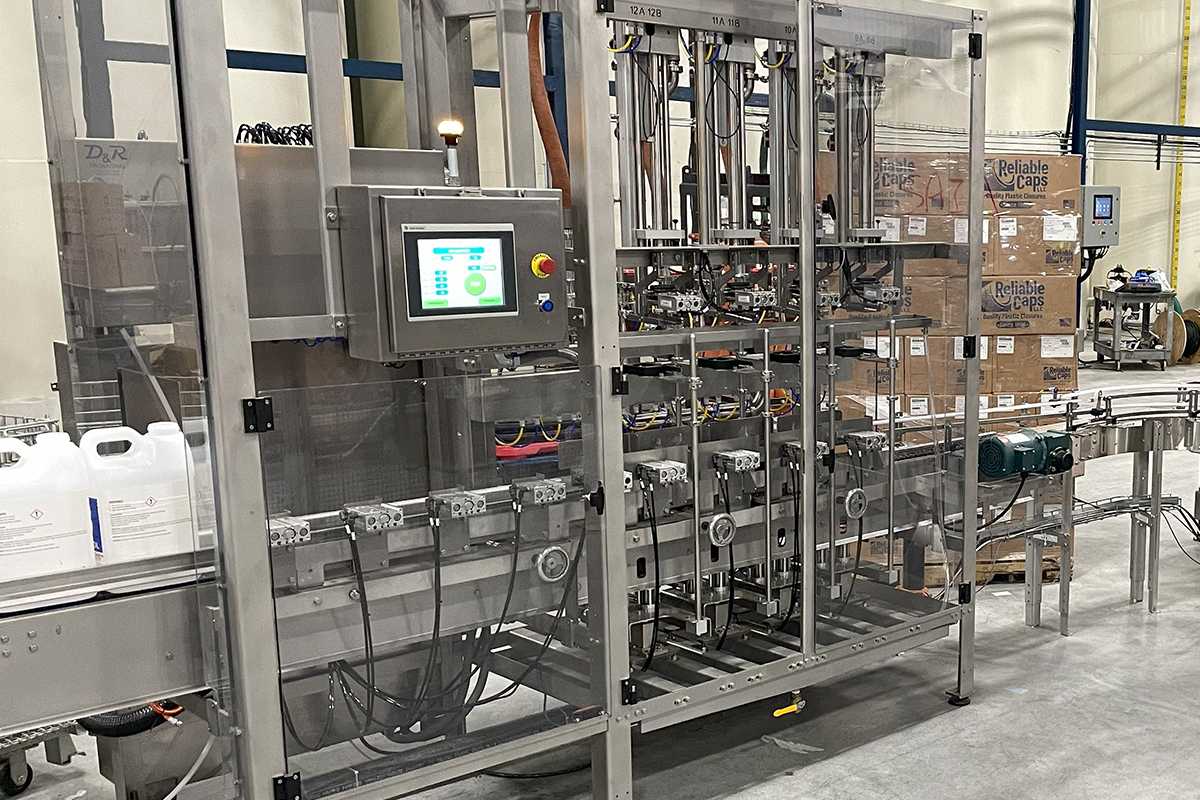
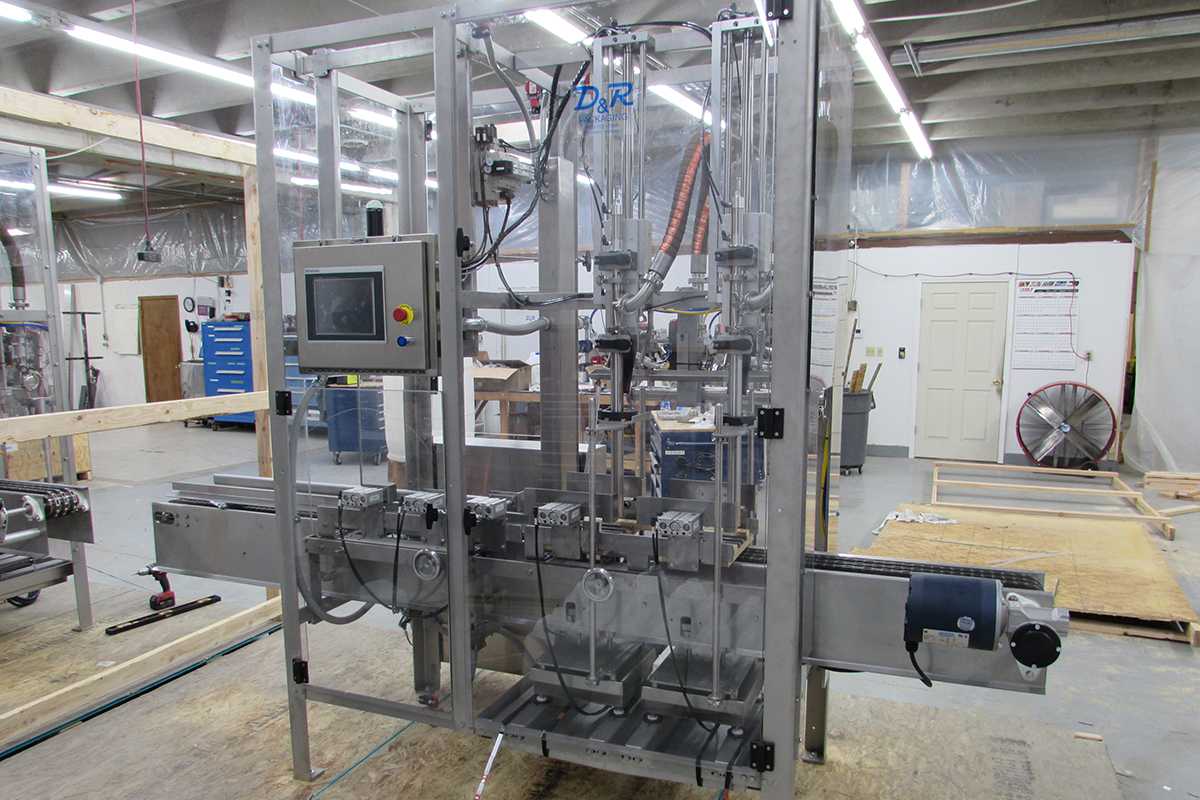
A net weight filler sets the pace for the whole line. If container feed, capping, or packing can’t keep up, the bottleneck just moves. More on net weight filling line integration.
That is why most of our filler projects turn into line projects. One example: a custom line built around a two-headed net weight filler running 2.5-gallon jugs at ten to fourteen per minute, with a stainless steel conveyor, gating system, neck locators, wipe-on labeler, Allen-Bradley PLC and touchscreen controls, automatic chuck capper, zero back pressure accumulation conveyor with induction sealer, and a case packing station with case taper and incline case labeler. Jugs go in empty and come out palletized.
See the build: Filling Line with Two Headed Net Weight Filler
We design and build the rest of that line too:
"EGE Products is an Ag Chemical manufacturing company, and D&R Packaging has been an integral part of our success.
Working with D&R Packaging on our Dual Automated packaging lines is simple and cost effective with their full service program including design, installation, and on-going support.
The customer service at D&R Packaging is top tier. They are available whenever I call and can provide excellent assistance with repairs, trouble shooting, and part acquisition. D&R Packaging goes out of its way to provide a quality product and to keep it running."
Jedidiah B.
Alex P.
John F.
Jim C.
The empty container is weighed in position on a scale, then a valve opens and fills it until the scale reaches your target weight. Most fills use a fast stage followed by a slow finish so the machine lands on target cleanly. Because the scale measures the actual product, density and viscosity changes do not throw off the result.
Volumetric fills a set volume, so if the density of the batch shifts, the finished weight shifts with it. Net weight fills to a weight, so the answer stays right regardless of density. More on the comparison.
On D&R systems, the fill consistency we target is plus or minus half a percent at full speed, using NTEP-certified scale hardware at 5,000 divisions. Real results depend on the container, the product, and the fluid supply, which is why we set pre-acts and scale setpoints against your actual product during startup.
Rate depends on container size, the fill opening, head count, product characteristics, required accuracy, and how well your fluid supply feeds the machine. As one real reference point, a two-head machine filling 2.5-gallon jugs runs ten to fourteen jugs per minute depending on the product. More on filler speed.
Our automatic inline systems handle containers from 16 oz to 5 gallons. Semi-automatic machines have no fixed size limit, though net weight filling is best suited to containers of 1 liter and up. More on container compatibility.
Yes. Drums and IBC totes fill on higher-capacity floor scales sized to your container. Automatic drum and tote filling is its own category of machine, which we build custom for each application. See our tote filling equipment.
Yes. Our explosion-proof machines are built to Class I, Division 1 as standard. If your facility's requirements allow a less restrictive design, we can build to your stated hazardous-area specification to reduce cost, with those design concessions defined and signed off by you. D&R does not classify production areas; that determination belongs to your facility. Bottom-up and subsurface fill also help by eliminating the free fall and splashing that generate static charge during flammable liquid transfer.
Changeover has two parts: repositioning the gates and neck locators for the new container, and swapping the wetted parts, which come apart without tools. These setups are typically completed in about ten minutes, and the recipe for the new product is recalled rather than rebuilt. More on running multiple SKUs and cutting changeover time.
Yes. Semi-automatic units use the same nozzles, valving, and scale decks as our automatic machines, so the fill itself is not a compromise. What you trade is throughput, because an operator is loading and unloading.
Often, yes. If the base machine is mechanically sound and the real problem is container handling, controls, or fluid supply, a retrofit is usually faster and cheaper than a new line. We will tell you honestly if the machine is not worth investing in.
It depends on head count, container range, level of automation, and whether a hazardous area or sanitary configuration is required. As a rough anchor, a semi-automatic unit typically costs a quarter to half as much as a fully automatic system, depending on options. Send us your containers, products, and target rate, and we will quote the actual configuration.
Yes. We are based in Merriam, Kansas, and have served customers across North America since 1986. The net weight fillers Kansas City manufacturers rely on are the same machines we install and support nationwide. Learn more about D&R.
Bring us the hard one. Send your product data, your container list, and your target rate, and we will tell you whether a semi-automatic unit, an automatic inline system, or a modification to what you already own is the right move. If we do not think you need new equipment, we will say that too.
Call (913) 722-6664 or request a quote online to scope custom net weight filling machines built for your products, your containers, and your line.