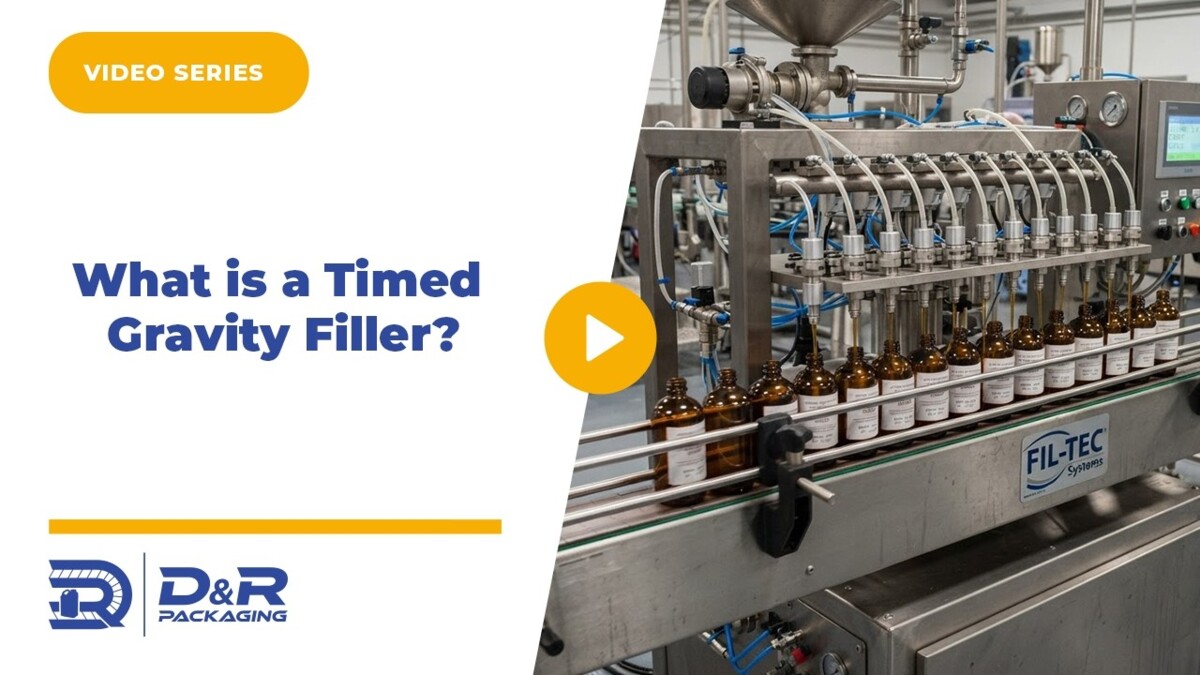
Production managers often ask how fast a net weight filling machine can run before they commit to new equipment. Using 2.5-gallon jugs as our baseline container size, our automatic net weight fillers deliver dependable, real-world throughput.
Top-end throughput reaches 8 to 10 jugs per minute on a two-head machine and 14 to 15 jugs per minute on a four-head machine. Container size is only the starting point, since other factors affect real speed.
How Fast Can a Net Weight Filling Machine Run By Head Count
Top-end throughput numbers change based on how many fill heads a machine has.
Two-Head Filler: 8 To 10 Jugs Per Minute
Using a 2.5-gallon jug as the baseline container, a two-head filler reaches 8 to 10 jugs per minute at top-end throughput.
Four-Head Filler: 14 To 15 Jugs Per Minute
The same baseline container on a four-head machine reaches 14 to 15 jugs per minute. Adding more fill heads does not scale throughput in a straight line, and we explain why later in this article.
Key Takeaway: Container size is the baseline for these numbers, but it is not the only factor. Viscosity, nozzle actuation, and manifold feed rate all affect actual throughput.
Factors Beyond Container Size that Affect Filler Speed
Multiple factors affect throughput on a filler besides container size, including product viscosity and the type of nozzle actuation required.
Product Viscosity And Nozzle Actuation
Product viscosity is one of the reasons real-world speed differs from a spec sheet number, and nozzle actuation needs are closely tied to it. Foamy products or products that require fumes mitigation call for specialized nozzle actuation, which changes the fill cycle. We also note that filling slower than a machine is capable of can yield fill accuracies even greater than the normally expected plus or minus half a percent.
Manifold Feed Rate: 120 Gallons Per Minute at 3 to 5 Psi
Our standard practice is to feed liquid to the filler’s main manifold inlet at 120 gallons per minute at 3 to 5 psi during each fill cycle. This maximizes the liquid filling rate during the high-volume portion of the fill sequence, which reduces the filling time per bottle.
Need expert help sizing a net weight filling system for your product? Contact D&R Packaging for a free consultation.
Why Indexing Time Affects Filler Speed as Much as Container Size
It is important to minimize the time spent putting liquid into a jug because on a net weight filler, a significant amount of time is also required for indexing and isolating bottles at each filling station.
Bottles are Not Run Butt-to-Butt
Unlike simpler filling machines, bottles on a net weight filler are not run into the filling station butt-to-butt. Time must be spent creating gaps between the bottles as they are fed into the filler.
Pro Tip: If you are evaluating fill head count for a new line, weigh indexing time against fill time. More heads only help throughput up to a point.
Why a Four-Head Filler is Near the Practical Maximum
For this same reason, we have found that a four-head filler is near the practical maximum number of fill heads on an inline net weight filler. Adding more fill heads runs into diminishing returns on throughput, based on the time required to index more bottles into more filling stations.
Getting an Accurate Speed Estimate for Your Line
Top-end throughput numbers give you a baseline, but your actual speed depends on your container size, your product’s viscosity, and whether your nozzles need special actuation for foam or fumes. Manifold feed rate and indexing time both factor into the real number as well.
How Fast Can A Net Weight Filling Machine Run For Your Product
The only way to know how quickly a net weight filler can run on your specific product is to review these variables with someone who specifies this equipment daily. Container size, viscosity, nozzle needs, feed rate, and indexing time all interact to set your real-world speed.
Talk To D&R Packaging About Your Fill Line
If you want a throughput estimate for your product and container, our team can walk you through it.