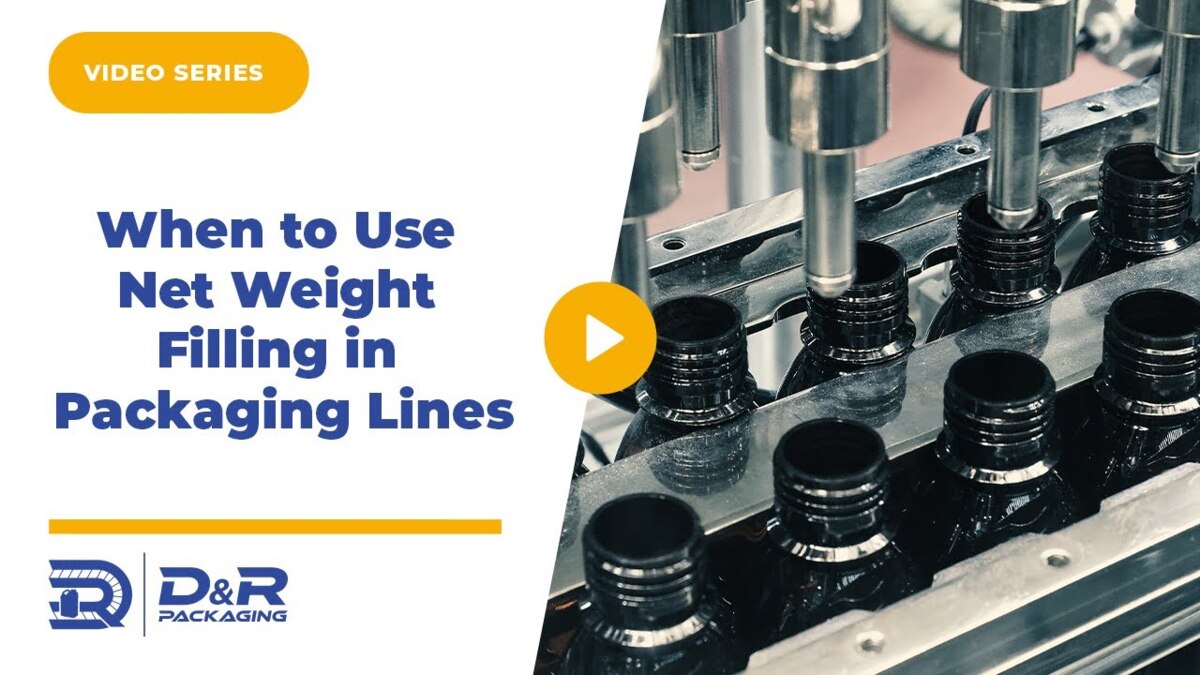
Net weight filling in packaging lines is used when yield control, accuracy, and repeatability directly impact production costs and profitability. Manufacturers rely on this method to maintain precise target weights across varying container types, product densities, and batch sizes while reducing overfill and product loss.
When Net Weight Filling in Packaging Lines is the Best Fit
The bottom line is simple. Net weight filling is usually the best choice when you are filling a larger volume of high-value product. In those operations, you care most about how much product leaves the plant in each bottle based on a known density and a target weight.
High-Value Product and Yield Loss Concerns
If you are very concerned with yield loss, net weight filling becomes compelling quickly. The method focuses on the target weight you set, which supports accurate fills bottle to bottle.
That accuracy can be cost-justified fast, especially when the product value is high, and even small losses add up across production runs.
A Wide Variety of Products and Fast Changeovers
Net weight filling is also ideal for customers who run a wide variety of products or batched products with different physical consistencies. When product profiles change often, you need a filler that can change over quickly and efficiently.
With saved setups in recipes, you can move between products with various consistencies without rebuilding the process from scratch each time.
Key Takeaway: If you run frequent changeovers and you are highly focused on yield loss, net weight filling is a strong driver because it is both versatile and accurate.
Why Fill Level Appearance Can Mislead Decisions
Some packaging lines choose a method based on shelf presentation. That can make sense in certain categories, but it is not the main goal in industries that use net weight filling.
Overflow Filling Works When Level-To-The-Eye Matters
If you are filling orange juice, an overflow filler can be a great fit because each bottle will be filled to the same level to the eye. That visual consistency is valuable when shelf appearance drives purchasing decisions, and the product category expects a uniform fill line.
Bottle Inconsistency Creates a Drawback for Level-Based Methods
In industries that typically use net weight filling, fill level appearance can create a drawback. Bottles can be inconsistent due to how they are molded or due to changing suppliers. In those cases, the level or apparent volume in the bottle does not determine fill accuracy per bottle.
What matters more is how much product of known density leaves the plant in that bottle. That is the measurement net weight filling is built around.
Need expert help with net weight filling? Contact D&R Packaging for a free consultation.
What Makes Net Weight Filling Versatile Across Product Types
Versatility is one of the main reasons operations choose net weight filling. It can handle a broad range of consistencies, and it can adapt to difficult products that cause problems for other fill methods.
Handles Viscosity Range from Non-Viscous to Honey-Like
Net weight fillers can run products from non-viscous all the way to almost honey viscosities. This range is supported by how the wetted parts are designed and how the system integrates with various pumping systems.
That flexibility matters when your line runs multiple SKUs with different flow characteristics, and you want one platform to cover the range.
Foamy Products and Programmable Fill Methods
Foamy products can be hard to handle on other systems. For example, a foamy product might foam over the holding tank of an overflow filler. Net weight fillers can handle those products because they use programmable fill methods for nozzle placement during fill.
Use a subsurface fill for foamy products. Build those setups into recipes so the system recalls the correct method during changeovers, and you can move fast between different consistencies.
Pro Tip: If foaming has caused overflow issues or cleanup downtime on your line, ask about programmable nozzle placement and subsurface fill options.
Where Other Filling Methods Can Create Limits
Other filling methods can be accurate, but they are not always friendly to every product type. This is often where net weight filling separates itself as a more universal option for mixed product lines.
Piston Fillers Can Be Accurate But Not Product-Friendly
A piston filler can be very accurate, but some products are not as friendly to pistons. Certain product types, such as urea-based products or rubbing alcohol, may not be ideal for piston systems.
Net weight filling does not rely on piston compatibility, which helps with challenging products.
Why Density and Target Weight Drive Accuracy
Net weight filling works best when you batch chemicals, measure density, and fill each bottle to the target weight you set.
This is one of the clearest reasons net weight filling fits high-value product lines. Accuracy connects to yield, and yield connects directly to cost.
Why Net Weight Filling Often Justifies Cost Quickly
Two themes drive most decisions here: versatility and accuracy. If you change over a lot and you care about yield loss, you will be driven toward net weight filling. Those benefits tend to cost-justify quickly, especially when the product value is high, and the line runs many different products.
If you want an accurate, versatile filler that supports fast changeovers across product consistencies, schedule a consultation with D&R Packaging today for net weight filling on your packaging line.